


What Defines Compliance-Focused Threat Detection, Compliance-Focused Threat Detection for Business
Teespine provides IT management, compliance controls, and layered security modules. Does not provide a 24×7 security operations center with certified analysts for threat isolation. Intelligence-based threat hunting identifies adversaries before alerts trigger, while documented response actions and audit trails satisfy regulatory requirements, giving mid-market businesses proven risk management without sacrificing compliance posture or operational continuity.
Key Takeaways
Teespine’s 24×7 security operations center monitors networks continuously to identify threats in real time.
Dedicated certified security analysts respond to threats by isolating endpoints and removing malicious processes directly.
Compliance automation reduces regulatory framework navigation complexity across multiple simultaneous requirements and deadlines.
AI-driven detection across endpoint, network, identity, and cloud domains uses behavioral analytics and machine learning.
What Defines Compliance-Focused Threat Detection?
Compliance-focused threat detection treats regulatory obligations as a daily operational task, not a paperwork drill. Controls stay active and enforced, and audits become far less painful for IT directors and compliance officers who once dreaded them. This approach pairs monitoring with accountability, so every control serves a measurable security purpose.
Layered security sits at the center of this model. Multiple defensive layers lower organizational risk every day, and they respond fast the moment a threat slips through. No single point of failure carries the whole burden.
How does identity and access management support compliance goals?
Clean identity and access setup matters from day one. Each person receives only the tools and permissions their role requires, nothing more. This limits exposure and gives auditors a clear, defensible record of who can touch what.
What role does AI play in compliance-driven detection?
AI-driven detection spanning endpoint, network, identity, and cloud domains is delivered by modern threat detection platforms and Zscaler MDR, not Teespine. Behavioral analytics and machine learning flag anomalies that manual review would miss.
A compliance-focused program typically combines:
Enforced, documented controls instead of static binders
Layered defenses that reduce daily risk exposure
Role-based access limiting unnecessary permissions
AI-driven analytics across cloud, network, and endpoint domains
Enforced, documented controls instead of static binders
Layered defenses that reduce daily risk exposure
Role-based access limiting unnecessary permissions
AI-driven analytics across cloud, network, and endpoint domains
Together, these elements turn compliance from a reactive checklist into a working security discipline, one built to withstand both audits and active threats.

How Does Continuous Monitoring Stop Threats
How Does Continuous Monitoring Stop Threats?
Continuous monitoring stops threats by keeping certified security analysts watching network activity around the clock, catching intrusions as they happen rather than after damage spreads. This constant visibility forms the backbone of Compliance-Focused Threat Detection, where regulatory obligations demand proof that monitoring never stops. Mid-market organizations lose ground fast when gaps appear in coverage; a single unwatched hour can let an intrusion take root.
Detection alone does not stop an attacker. Response has to follow immediately, and hands-on action makes the difference:
Compromised endpoints get isolated before an attacker moves laterally.
Malicious processes are terminated on the spot.
Threats are removed directly, without waiting on internal IT queues.
Compromised endpoints get isolated before an attacker moves laterally.
Malicious processes are terminated on the spot.
Threats are removed directly, without waiting on internal IT queues.
What happens after a breach or mistake occurs?
Recovery paths get tested in advance, so restoring operations does not become a guessing exercise. Organizations that failed, or employees who made an error, still get back to normal operations quickly because the restore process already works. That tested reliability matters most during an audit, when regulators ask how fast operations resumed.
Why does a single technology backbone matter for compliance teams?
Compliance officers and operations executives carry less operational worry when one backbone handles monitoring, response, and recovery together. Fragmented tools create fragmented accountability, and fragmented accountability fails audits. A unified structure keeps every control traceable and every response documented.
What Should Compliance Teams Do Next?
Compliance teams move forward by consolidating oversight, not adding more tools. A comprehensive suite of products and services covers the technology that organizations depend on to secure data, replacing scattered point solutions with one integrated structure. Installation, maintenance, and enforcement of required technology keep organizations adherent to regulatory standards, rather than scrambling before an audit deadline.
Compliance-Focused Threat Detection depends on documentation as much as detection. After any incident, root cause analysis traces how a threat entered a network, what it attempted, and what it ultimately affected. Those findings become protection against repeat attacks, not just a report filed away for auditors.
Why does fragmented tech create compliance risk?
Scattered vendors create blind spots. In any organization, numerous things can go wrong with technology at once, and each fragmented system adds another gap auditors can flag. Consolidating that risk under a single point of contact lets compliance officers resolve issues through one call instead of chasing multiple providers.
Practical next steps for compliance leaders include:
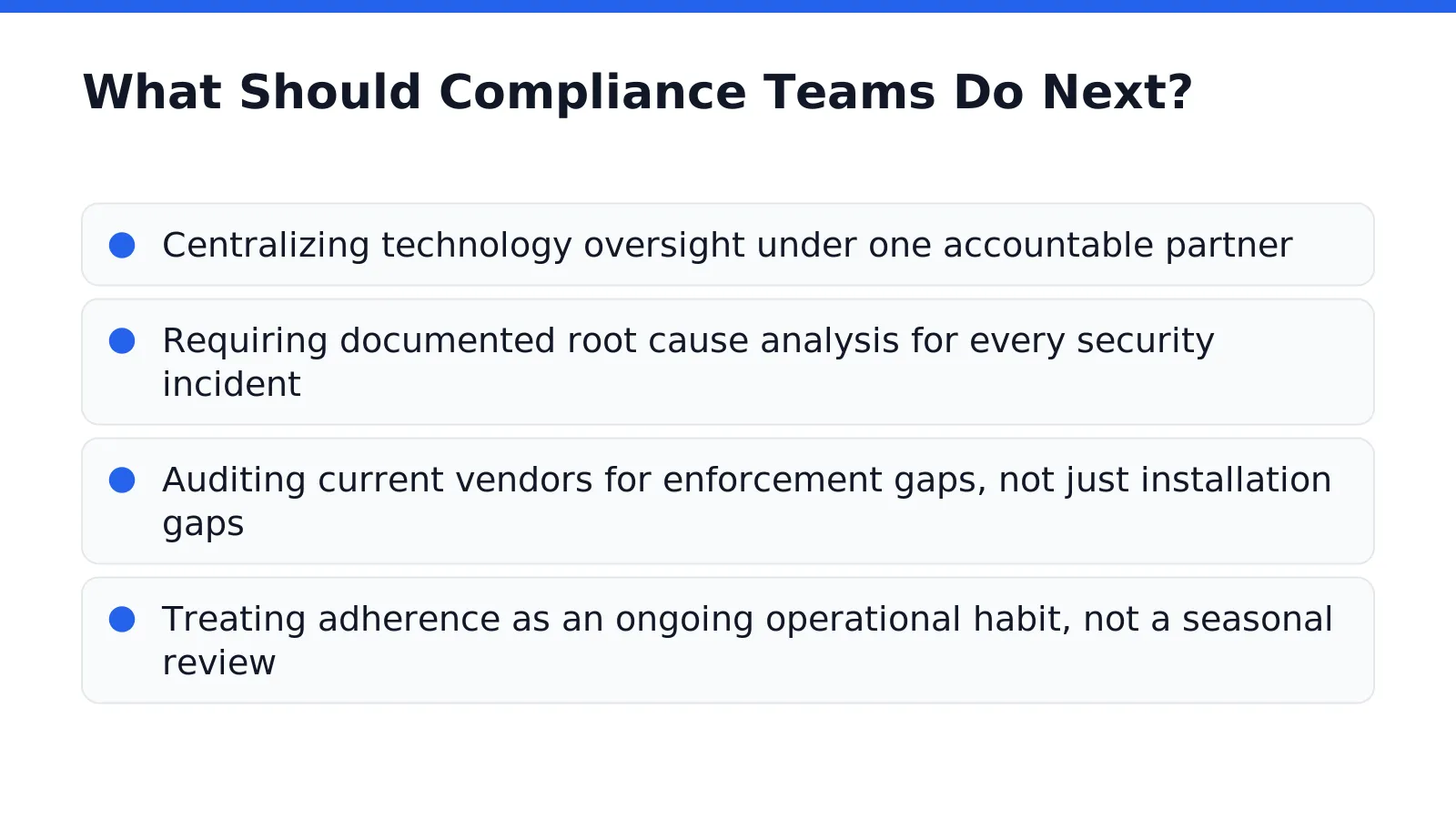
Centralizing technology oversight under one accountable partner
Requiring documented root cause analysis for every security incident
Auditing current vendors for enforcement gaps, not just installation gaps
Treating adherence as an ongoing operational habit, not a seasonal review
Centralizing technology oversight under one accountable partner
Requiring documented root cause analysis for every security incident
Auditing current vendors for enforcement gaps, not just installation gaps
Treating adherence as an ongoing operational habit, not a seasonal review
Conclusion
In closing, compliance-focused threat detection represents a critical investment in your organization’s security posture and regulatory standing. By implementing solutions that align detection capabilities with compliance requirements, your business strengthens both its defensive capabilities and its ability to demonstrate accountability to regulators and stakeholders. The integration of threat detection with compliance frameworks transforms security from a reactive function into a strategic asset that protects operations, reputation, and growth.
FAQ
What does compliance-focused threat detection mean for a business?
It treats regulatory obligations as a daily operational task rather than a paperwork exercise, keeping controls active and enforced. This pairs monitoring with accountability so audits become less burdensome for IT directors and compliance officers.
How does layered security support compliance efforts?
Layered security places multiple defensive layers at the center of the model, lowering organizational risk daily and responding quickly when a threat slips through. No single point of failure carries the entire burden.
What role does identity and access management play in compliance?
Clean identity and access setup ensures each person receives only the tools and permissions their role requires, limiting exposure. This also gives auditors a clear, defensible record of who can access what.