


Nonprofit cyber threat monitoring combines layered security tools with tested backup. Recovery plans to catch risks like phishing scams before damage spreads. Teespine’s seven service modules cover identity and access, data protection, and compliance operations, giving nonprofits handling donor PII and online donations continuous oversight without requiring dedicated IT
Key Takeaways
Nonprofits handling donations, registrations, or personal data face immediate cybersecurity risks requiring urgent action.
Limited budgets and lack of dedicated IT staff create eight distinct cybersecurity challenges for nonprofits.
Public-facing donation platforms and volunteer systems attract cybercriminals targeting vulnerable nonprofit organizations.
Data breaches damage nonprofit reputation and donor trust beyond financial losses incurred.
Why Are Nonprofits Prime Cyber Targets?
Donation platforms, volunteer databases, and beneficiary records create a uniquely exposed digital environment for charities and nonprofits. Limited budgets and a shortage of dedicated IT staff leave many organizations without the defenses that larger enterprises take for granted. Cybercriminals recognize this gap, and they treat it as an opening.
Phishing scams rank among the most common attack methods used against organizations today, and nonprofits are no exception. Attackers send fraudulent emails designed to trick staff or volunteers into revealing credentials or financial information. Without consistent cyber threat monitoring and detection, these attempts can go unnoticed until real damage occurs.
The stakes extend beyond dollars lost. A breach can erode public trust, interrupt program delivery, and shrink future funding when donors question an organization’s reliability. Nonprofits holding donor or client personal data carry real risk, both to that data and to the people it represents.
What Makes Nonprofits More Vulnerable Than Other Organizations?
Nonprofits often run lean operations, stretching every staff member across multiple roles. That structure leaves little room for dedicated security oversight, making gaps easier for attackers to exploit.
What Data Do Cybercriminals Target at Nonprofits?
Donor payment details, beneficiary records, and volunteer contact information top the list. These assets hold value for criminals and carry heavy consequences for the people and causes they belong to, including:
Donor financial and contact records
Beneficiary personal information
Volunteer and staff credentials
Donor financial and contact records
Beneficiary personal information
Volunteer and staff credentials
What Does Continuous Threat Monitoring Involve?
Cyber Threat Monitoring and Detection combines layered security controls with ongoing attention to how a nonprofit’s systems behave day to day. Layered security reduces risk on a continuous basis and responds fast once something slips past the first line of defense. For a nonprofit handling donor records, beneficiary files, and financial data, that speed matters more than any single tool.
Monitoring doesn’t stop at watching for intrusions. Disaster recovery planning pairs with attack-attempt audits. A nonprofit can catch suspicious activity and recover operations once an incident occurs. These two functions work together: detection flags the problem, recovery gets services running again.
What areas does a monitoring program actually cover?
A monitoring program treats data security, user management, and succession planning as connected, not separate tasks. Losing a staff member with admin access, for instance, creates exposure unless user permissions get updated immediately. Succession planning closes that gap before it becomes a breach.
Does monitoring help with compliance requirements?
Compliance works best as an operational practice, not paperwork filed away in a binder. Continuous monitoring puts controls in place, keeps them enforced, and makes audits far less painful for boards and operations staff.
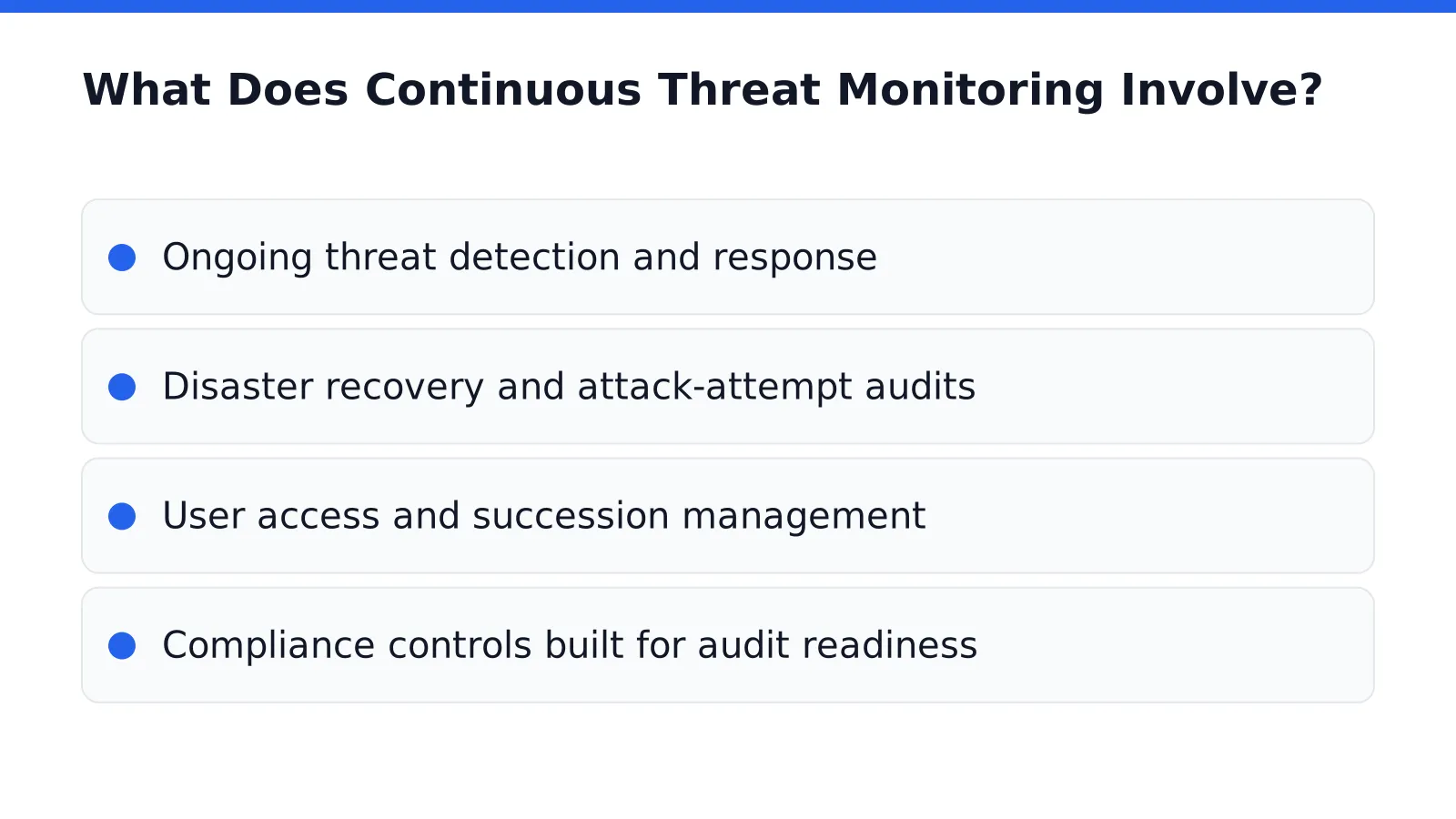
A full suite of products and services supports the technology nonprofits depend on to secure their data, covering:
Ongoing threat detection and response
Disaster recovery and attack-attempt audits
User access and succession management
Compliance controls built for audit readiness
Ongoing threat detection and response
Disaster recovery and attack-attempt audits
User access and succession management
Compliance controls built for audit readiness

How Can Nonprofits Build Lasting Protection?
Lasting protection starts with a single accountable partner rather than a patchwork of vendors. A hundred things can go wrong with technology inside any organization, and nonprofits with lean IT staff feel every one of them. One point of contact resolves issues faster because nobody gets passed between contractors while donor records sit exposed.
Cyber threat monitoring and detection works best paired with recovery planning that’s already tested before an incident happens. Backups, restore paths, and continuity plans only matter if they’ve been verified in advance, not discovered mid-crisis.
Lasting protection also depends on structure. Consider these pillars:
A single technology backbone that removes guesswork from daily operations
Documented, tested backup and restore procedures
Ongoing guidance on cybersecurity, compliance, and IT management as threats shift
A single technology backbone that removes guesswork from daily operations
Documented, tested backup and restore procedures
Ongoing guidance on cybersecurity, compliance, and IT management as threats shift
What does “Technology Backbone” mean for a nonprofit?
Serving as an organization’s technology backbone means one partner, headquartered in Lakewood, New Jersey, handles the full range of IT and security needs. Leadership teams push forward on mission work without carrying a background worry about data exposure or system failure.
How often should backup and continuity plans be tested?
Backup systems and restore paths require regular, documented testing, not occasional spot-checks. Continuity planning that isn’t verified routinely offers false confidence until a real outage proves otherwise.
FAQ
Why do nonprofits need cyber threat monitoring?
Donation platforms, volunteer databases, and beneficiary records create an exposed digital environment, and limited budgets with no dedicated IT staff leave gaps that cybercriminals exploit through phishing and other attacks.
What does Teespine’s monitoring approach include?
Teespine combines layered security tools with tested backup and recovery plans across seven service modules covering identity and access, data protection, and compliance operations, giving nonprofits continuous oversight.
What data does cyber threat monitoring protect at nonprofits?
Monitoring protects donor financial and contact records, beneficiary personal information, and volunteer and staff credentials, assets that carry heavy consequences for the people and causes they represent.
Conclusion
In closing, cyber threat monitoring stands as a foundational investment for nonprofit organizations seeking to protect donor data, operational continuity, and mission-critical systems. By implementing consistent monitoring practices, nonprofits strengthen their security posture while demonstrating accountability to stakeholders and funders. Teespine remains committed to delivering the expertise. Support your organization needs to navigate today’s evolving threats with confidence and resilience.